Energy Demand Forecasting
Benchmarked classical time-series models against an LSTM on 143K+ hourly records.
- 58% forecast error reduction
- 143K+ hourly records
- LSTM
- ARIMA
- Holt-Winters
- Power BI
- DAX
Executive Summary
Problem
Accurate short-term energy demand forecasts are needed for planning, but it's not obvious whether classical time-series methods or a neural approach makes more sense for the tradeoff between accuracy and complexity.
Approach
- 01
Cleaned and explored 143K+ hourly demand records, engineering lag and rolling-window features to prepare the data for both classical and neural models.
- 02
Benchmarked ARIMA, Holt-Winters, and an LSTM against each other on 143K+ hourly demand records.
- 03
Trained the LSTM on engineered sequence features rather than raw hourly values.
- 04
Surfaced results in an interactive Power BI dashboard with custom DAX measures for stakeholder communication.
Results
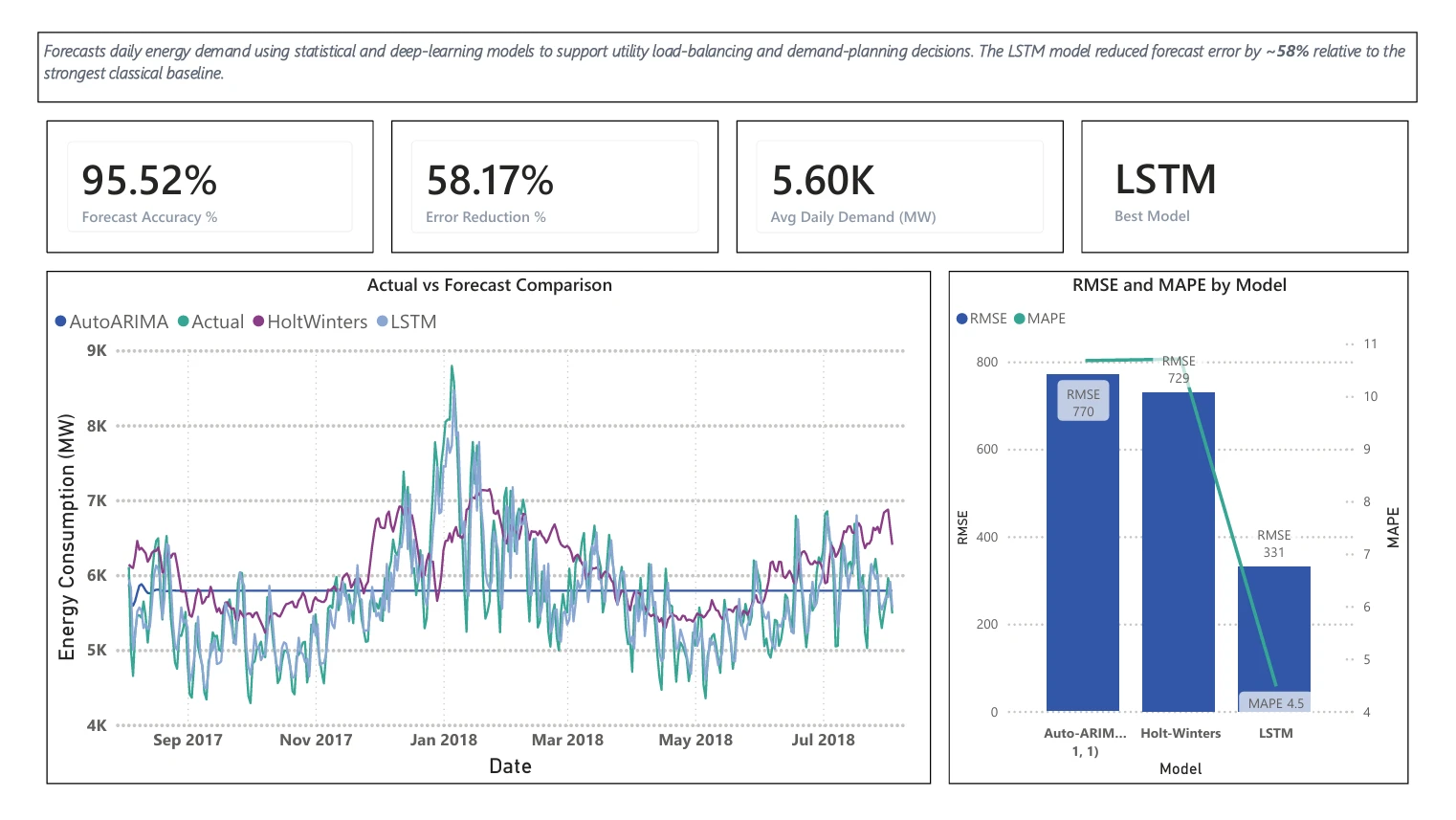
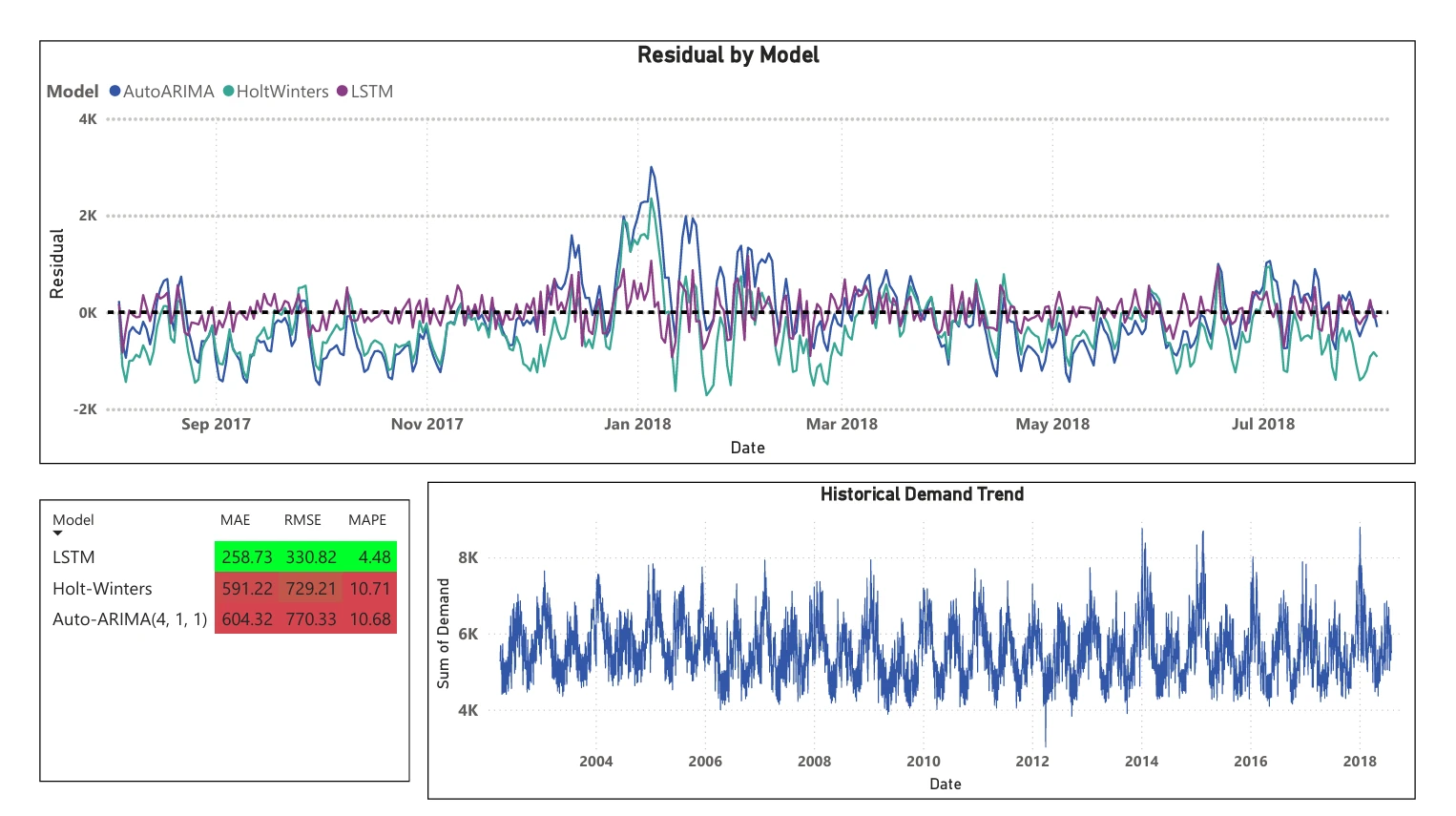
The LSTM on engineered sequences cut forecast error by 58% compared to the classical baselines, reaching 95.52% forecast accuracy.
This confirmed the added model complexity was worth it — Holt-Winters was the strongest classical baseline, but still fell meaningfully short of the LSTM.
What I'd improve
Add external features (weather, calendar effects) to the sequence model.